What is Open Access?
Open Access (OA) publishing refers to digital publications that offer free and easily accessible scholarly research to readers. This publishing model differs significantly from traditional publishing models, which (often) require readers to pay a substantial subscription fee or be affiliated with a significant academic body – such as a university or library – to access the research published in their journals.
The OA model was born in the 1990s from the overlapping ambitions of the dot-com revolution and the knowledge economy. At the time, most – if not all – published academic research was sealed behind paywalls that limited public access to innovations from the academic community.
OA was presented as an alternative model to traditional publishing, with the internet era allowing for more global accessibility than ever before. It enabled academics to develop a healthier research ecosystem, built on a mutual goal of making the world a better place through shared scientific discovery.
Why Publish Open Access
The OA publishing model is a growingly prominent method employed by journals that see the value in being part of the ‘Open Science Revolution’. This is because OA has a significantly positive influence on the research ecosystem.

Many individual benefits come with adopting an OA model for your journal or publishing your work in one, namely an increased chance of being cited by other researchers and the development of a solid reputation in the academic space.
However, there are also collective benefits to exploring OA publishing models that allow you to give back to the same society that supported your success. Before the 1990s, many grievances in the academic community were linked to paywalls and the inaccessibility of research often funded by public institutions and the government. Many researchers in the Global North believed it was paradoxical that public institutions supported a significant share of research and would have to pay again later to access it.
OA is the answer to these grievances.
How Does Open Access Work?
The OA publishing model allows authors to publish their work in easily accessible scholarly journals. This model aims to reduce the cost of knowledge for academics and other members of society looking to learn from and expand on peer-reviewed research. But how does this business model function without the usual subscription-based revenue enlisted by traditional models?
OA models utilise three primary revenue sources: through institutions, consortia, or article processing charges (APCs). The type of revenue source implemented will depend on the OA model publishers use.

For example, KnE Publishing employs the Diamond model, which does not charge APCs to research authors. While APCs are known to be the dominant model used by some OA publishers – particularly those who subscribe to the gold model of OA –they are not as common as once believed. According to the Open Access Network, of the 17,136 journals listed in the Directory of Open Access Journals (DOAJ), 11,948 did not levy any APCs (2021). This growing aversion to APCs is rooted in fear of perpetuating unequal prerequisites for access to publishing opportunities. Not all academics can access private funds or institutional grants, particularly in the Global South.
Debunking Open Access
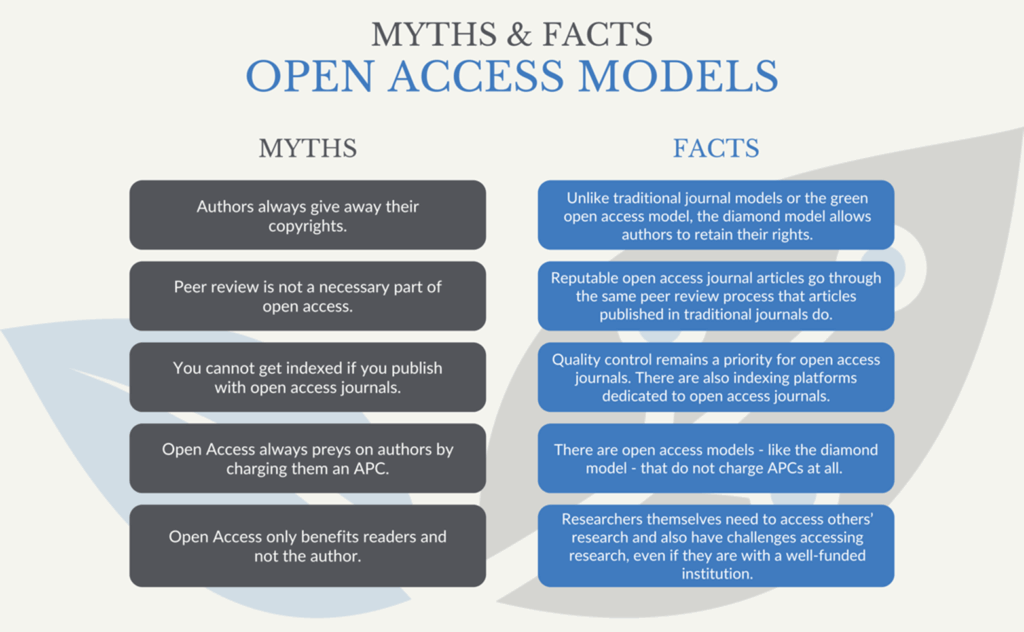
Open access, while incredibly beneficial for researchers and the overall academic ecosystem, has been a victim of many myths that deter researchers and institutions from taking advantage of its uses. In a recent online survey conducted by the Knowledge E Foundation, we discovered that in the MENA region alone, 26% of responders believed open access was synonymous with predatory publishing. In comparison, 30% did not know what open access was, and 53% did not know that open access allows you to retain copyright ownership.
Many of these myths and misunderstandings have emerged due to a lack of exposure to reliable, transparent, open access publishers and can largely be debunked with the correct information.